



Share This Article
Studio apartments in India are increasingly common — in Bengaluru, Mumbai, Delhi, and Hyderabad, where single professionals and young couples prioritise location over space and end up with one room that must function as bedroom, living area, kitchen, and workspace.
The design challenge is not aesthetic. It is functional: how do you create psychological separation between sleeping, working, eating, and relaxing in a single open space?
These ten ideas address that challenge directly.
Table of Contents
1. Zone the Space Without Walls {#zones}
The most important principle in studio apartment design is zone creation — dividing the single room into distinct areas that feel different from each other, encouraging different behaviours in each.
Zones are created through furniture arrangement, rugs, lighting, and colour — not walls. A rug under the bed defines the sleeping zone. A rug under the sofa and coffee table defines the living zone. A pendant light over the dining table defines the eating zone. Each zone has its own contained quality even though the room is open throughout.
Keep the transitions between zones clean. Furniture should face into its own zone rather than across the room. The back of a sofa can serve as a spatial divider between the living and sleeping zones.
2. Choose the Right Bed {#bed}
In a studio, the bed is both the most necessary and the most space-consuming piece of furniture. Three options work well in Indian studios:
Murphy wall bed — folds into the wall during the day, freeing the entire sleeping zone for other uses. The best option for studios where the room genuinely needs to be a living space during waking hours. Higher initial cost but transformative on daily usability.
Daybed or sofa bed — functions as seating during the day and as a sleeping surface at night. Quality varies enormously — a sofa bed that is genuinely comfortable as both requires a ?20,000 to ?50,000 investment. Cheap sofa beds are uncomfortable as either.
Low platform bed with a defined zone — if space permits, a low bed with a rug and canopy-style curtain hanging from the ceiling creates a defined sleeping zone within the studio. The visual separation is psychological but effective.
3. The Kitchen and Dining Area {#kitchen}
Most Indian studio apartments come with a small kitchenette area — either open to the main room or separated by a partial partition. The dining arrangement needs to be compact.
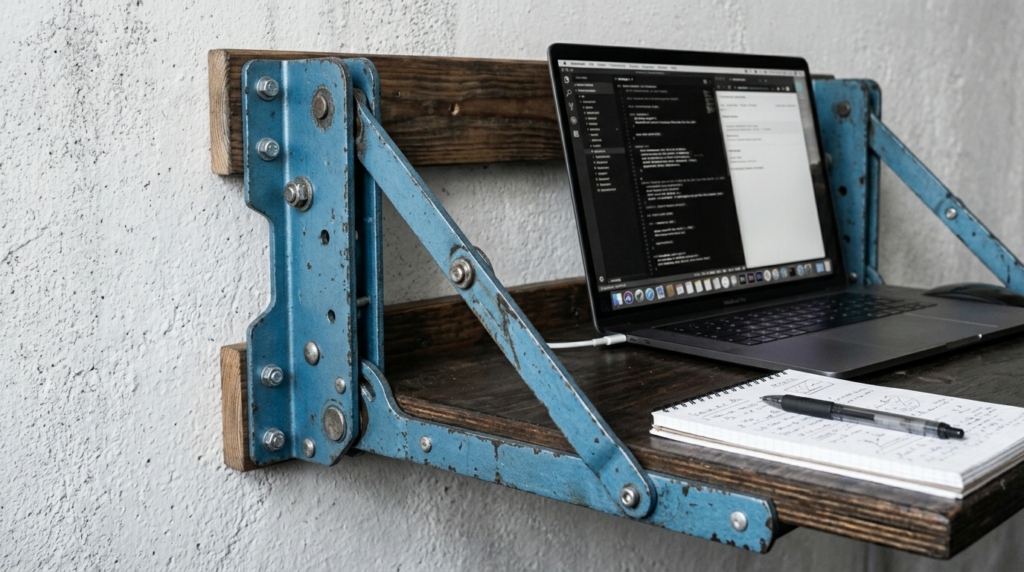
A wall-mounted fold-down table used only during meals frees the floor area completely when not in use. A two-person table with foldable chairs takes up less permanent floor area than a fixed table and chairs. A kitchen island on wheels can serve as a prep surface, bar counter, and — with stools — a dining surface.
Keep the kitchen visually clean — a cluttered open kitchen makes the entire studio feel smaller. Cabinet-front organisers, closed storage, and minimal counter items help significantly.
4. Workspace in a Studio {#workspace}
Working from home in a studio requires a dedicated workspace — even a small one — that can be mentally separated from the sleeping and living areas.
A wall-mounted fold-down desk is the most space-efficient option. A narrow desk (45cm depth) along one wall with a foldable chair takes minimal floor area. In a pinch, a dedicated corner of the kitchen counter with a portable laptop stand and good lighting constitutes a functional workspace.
The key is that the workspace has its own defined location — not a laptop on the bed, which blurs the psychological boundary between sleeping and working.
5. Storage Strategy {#storage}
Studio apartments demand aggressive storage planning. Every dead space must be used: under the bed, above door frames, on walls, inside ottomans, behind the sofa, and in corners.
The principle: all storage should be vertical and behind closed doors where possible. Visible clutter in a studio makes the entire room feel smaller and more chaotic. Built-in wardrobes floor to ceiling, closed kitchen cabinets, and lidded storage boxes all help maintain visual calm.
Related read: Storage ideas for small homes India ?
6. Colour Zoning {#colour}
Different tones in different zones create psychological separation without physical walls. This does not require painting — it can be achieved through rugs, curtains, cushion covers, and wall hangings in different tonal families.
A warm terracotta rug under the seating area and a cool blue-grey rug under the bed creates distinct zones through colour temperature alone. The sleeping zone and living zone feel different even though they share the same ceiling.
7. Lighting by Zone {#lighting}
Zone lighting is one of the most effective and affordable studio apartment design tools. Each zone should have its own light source that can be switched on independently — so the bedroom area is lit without illuminating the entire room, and the reading corner can be active while the workspace is dark.
Use warm-white plug-in lamps for the sleeping zone, a cooler task light for the workspace, and pendant or candle lighting for the dining area. The ability to control the lighting in each zone independently transforms the studio’s livability.
8. Mirror Placement {#mirrors}
A large mirror on one wall of a studio apartment — particularly opposite the window — reflects both light and space, making the room feel measurably larger. In a studio where the psychological weight of a single-room living situation can feel constricting, the visual expansion a mirror creates is genuinely valuable.
A full-length lean-to mirror (?500 to ?2,000) requires no drilling and can be repositioned to maximise its effect.
9. Vertical Space {#vertical}
In a studio where floor area is maximised for living functions, walls become storage. Floating shelves above the desk, kitchen, or sofa carry items that would otherwise be on the floor or cluttering surfaces.
Install shelves at ceiling height for infrequently accessed items — seasonal storage, books, display items. Keep lower shelves for regularly used objects.
10. Keep the Floor Visible {#floor}
The amount of visible floor area in a room directly affects how spacious it feels. In a studio, keeping the floor as clear as possible — through elevated furniture, wall-mounted solutions, and disciplined storage — makes the space feel larger regardless of its actual dimensions.
Apply the same principle as a minimal bedroom: if it is on the floor and has no fixed reason to be there, find it a proper home.
Related read: 1 BHK interior design ideas India ?
Final Thought
Studio apartment design in India is ultimately about creating a space that serves every function you need without feeling like it is doing all of them simultaneously. Zones, defined by rugs, lighting, and furniture arrangement, are the tool that makes this possible.
The studio is a constraint that, designed well, becomes a very efficient way to live.
More design guides for small Indian homes. Browse our full library ?