




Share This Article
Society maintenance charges are one of the most common sources of confusion and dispute in Indian apartment rentals. The rent is agreed and written down. The maintenance is often verbal, assumed, or buried in a line of the agreement that nobody read carefully.
Here is the complete picture — who pays, what a housing society can legitimately charge, and what falls outside their authority.
Table of Contents
What Are Society Maintenance Charges? {#what-are}
Society maintenance charges — also called maintenance fees or association fees — are monthly amounts collected by a Resident Welfare Association (RWA) or Apartment Owners Association (AOA) from residents to cover the cost of common area maintenance.
This typically covers: security personnel salaries, common area cleaning (lobby, corridors, gardens), lift maintenance and electricity for common areas, water for common areas and overhead tank, building insurance, and upkeep of amenities like gym, pool, or clubhouse where applicable.
The charges are set by the RWA in an annual general meeting and communicated to all residents — owners and tenants alike.
Who Pays — Tenant or Landlord? {#who-pays}
[IMAGE BLOCK 2 — Mid-article]
This is the most common question — and the answer is: whoever the rental agreement says.
There is no universal rule in India that assigns maintenance charges to either landlord or tenant by default. It is a matter of agreement between the two parties.
In practice, maintenance charges are sometimes included in the rent quote — meaning the landlord receives ?25,000 as rent but pays the ?3,000 maintenance themselves. Other times, the agreement specifies that maintenance is payable separately by the tenant on top of rent.
The key is that this must be explicitly stated in the rental agreement. If the agreement is silent on maintenance and the landlord later tries to pass it to the tenant — that is a hidden charge addition that you are not obligated to accept.
Before signing any agreement, ask: is the quoted rent inclusive or exclusive of society maintenance charges? Get the answer in writing.
Related read: Hidden charges when renting an apartment India ?
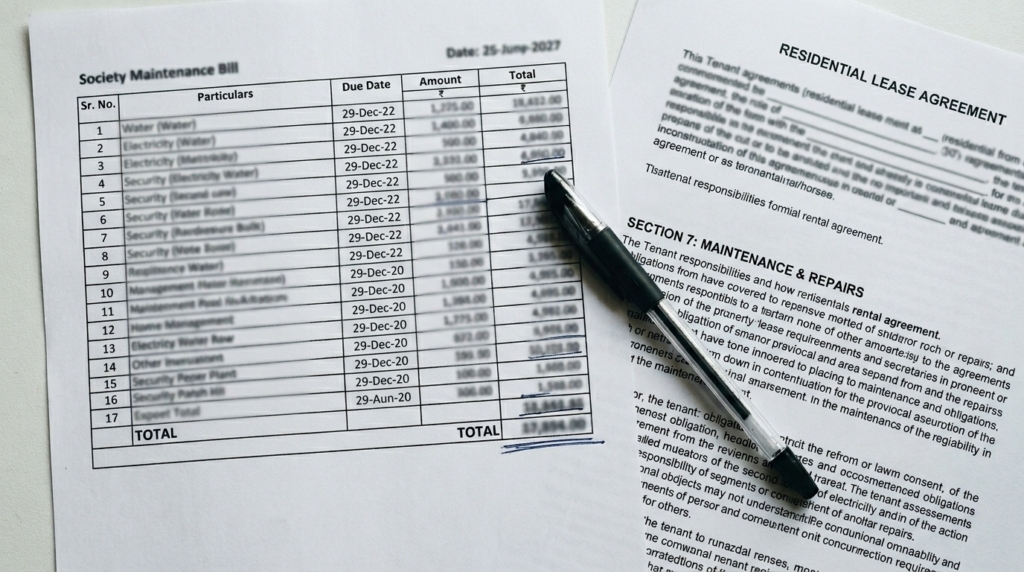
What Can a Housing Society Charge? {#what-can-charge}
Under the Model Bye-Laws for Housing Societies in India — which most states have adopted in some form — housing societies are permitted to charge:
Regular monthly maintenance for the cost of common services listed above. Sinking fund contributions — for long-term capital maintenance and building repair reserves. Major repair special levy — for significant one-time costs like lift replacement or terrace waterproofing, levied as a special assessment. Parking charges — if the society provides and manages parking infrastructure.
All charges must be approved in the RWA’s Annual General Meeting (AGM), documented in meeting minutes, and communicated to residents. Ad hoc charges without AGM approval are not valid.
What Societies Cannot Charge Tenants {#cannot-charge}
Several types of charges that housing societies sometimes impose on tenants are not legally valid:
Discrimination-based charges — charging higher maintenance from tenants than from owners for the same flat size and services is not permitted. All residents using the same facilities must be charged equally. Excessive move-in or move-out fees — while a nominal processing or security fee may be acceptable, large amounts described as “society entry charges” or “NOC fees” have been struck down by courts and consumer commissions. Charges not approved at AGM — any charge introduced between AGM cycles without proper process is not binding on residents. Property tax passing — a society cannot charge tenants for the property tax on the flat. That remains the landlord’s obligation.
The Move-In and Move-Out Fee Question {#move-in-fee}
Many housing societies in metro cities charge a “move-in fee” — sometimes called a building maintenance fee or shifting fee — when a new tenant moves in. Amounts vary widely: ?500 in some societies, ?5,000 or more in others.
The legal basis for these fees is limited. Courts and consumer commissions have held that societies cannot charge arbitrary amounts for the mere act of a new tenant moving in. A reasonable, AGM-approved processing fee for paperwork and security may be acceptable — but large move-in fees are challengeable.
Before committing to a flat, ask the building management about any move-in fee and get the amount in writing. Factor it into your total cost of moving.
Related read: Society rules for tenants in India ?
What to Do If You Are Overcharged {#overcharged}
If you believe the society is charging an amount that was not approved or is discriminatory, request the minutes of the AGM where the charge was approved. If the minutes don’t support the charge — write a formal complaint to the RWA Secretary requesting clarification or reversal.
If the society does not respond satisfactorily, file a complaint with the District Registrar of Co-operative Societies (or equivalent authority in your state) — this is the regulatory body that oversees housing societies in India. In states like Maharashtra, the Co-operative Court handles disputes between residents and housing societies.
For discrimination claims — being charged more than owners for the same flat and services — a consumer court complaint is also an option.
Final Thought
Society maintenance charges are legitimate — housing societies need funding to function. What is not legitimate is passing charges to tenants without agreement, inventing fees without AGM approval, or charging tenants more than owners for the same services.
Know what you agreed to in writing. Know what the AGM approved. And when something does not match either — ask for documentation before paying.
Navigate every aspect of apartment living. Browse our full guide library ?