



Share This Article
The living room in a typical Indian 1 BHK or 2 BHK apartment is between 150 and 200 square feet. That is not small — it is workable. The problem is almost always the furniture: a sofa too large for the room, a TV unit that dominates the wall, a coffee table that takes up the middle of the floor, and accumulated objects on every surface.
These ten changes address the most common small living room mistakes in India — and most of them cost nothing or very little.
Table of Contents
1. Resize the Sofa {#sofa}
The most common small living room mistake in India: a three-seater sofa in a room that can only comfortably hold a two-seater. The oversized sofa dominates the room, leaves almost no walkable floor area, and makes everything around it feel cramped.
Measure the living room before buying a sofa. A sofa should take up no more than one-third of the room’s total floor area. In a 150 square foot room, a two-seater (approximately 1.5m wide) leaves adequate space around it. A three-seater (approximately 2.1m wide) typically does not.
If you already have an oversized sofa — consider replacing it or supplementing the seating with a smaller armchair and removing one sofa seat’s worth of bulk.
2. Wall-Mount the TV {#tv}
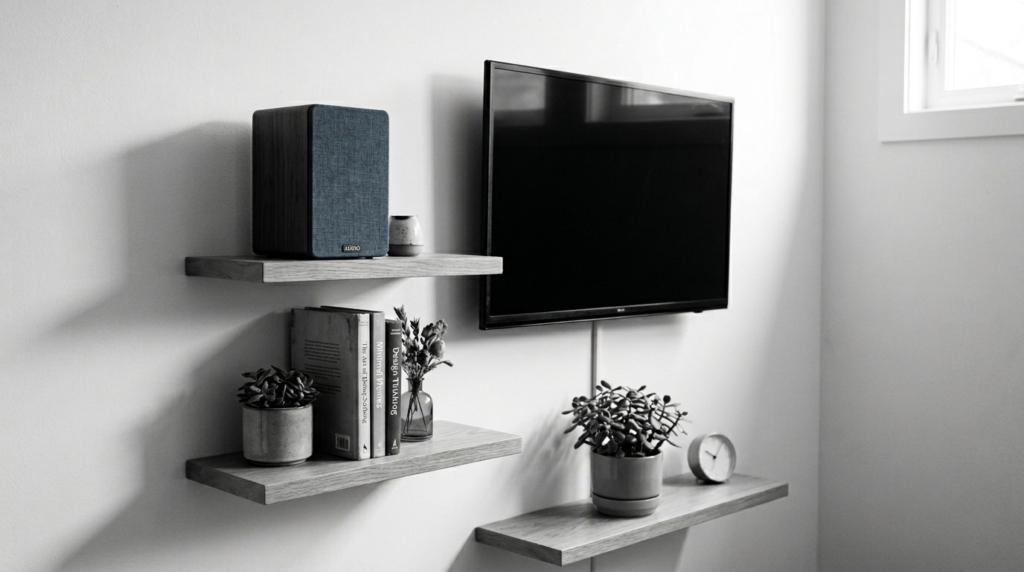
A wall-mounted TV eliminates the floor area of a TV unit — typically 0.3 to 0.5 square metres of floor space. It also raises the visual line of the room and makes the space between the sofa and the TV feel less congested.
The wall below a mounted TV can hold two or three floating shelves for speakers, remotes, books, and decorative objects — providing storage without the bulk of a TV cabinet. A single cable management raceway keeps cables hidden and clean.
Wall-mounting requires drilling in most cases — confirm with your landlord before proceeding, or choose a mounting stand that sits on the floor but holds the TV at the same height as a wall mount.
3. Define the Space with a Rug {#rug}
A rug anchors the living room furniture into a coherent zone. Without a rug, a sofa and coffee table in a living room look like they are floating in the room without belonging to it.
The rug should be large enough for the front legs of all seating furniture to rest on it. In most Indian 1 BHK living rooms, this means a rug of approximately 160 x 230cm. Smaller rugs make the room feel more fragmented, not more spacious.
4. Remove the Coffee Table {#coffee-table}
A solid coffee table in the centre of a small living room takes up the most valuable floor area in the room — the open space between the sofa and the TV wall. Removing it immediately creates a sense of spaciousness.
Replace with: a small side table beside the sofa arm (takes almost no floor area), a lightweight pouf that can be moved (serves as table or footrest), or nesting tables that are stored flat and pulled out when needed.
5. Use Vertical Shelving {#shelving}
Wall-mounted floating shelves from floor to ceiling on one wall create storage and display space without taking floor area. In a small living room, a full-height shelving wall — even if narrow — is more functional and visually interesting than the same number of objects on a low media console.
Floating shelves are available in India from IKEA, Pepperfry, and local hardware stores. A carpenter-built unit can be sized exactly to your wall.
6. Choose Light Colours {#colour}
Light colours on walls and large furniture reflect more light and make rooms feel larger. In a small living room, a dark sofa against a dark wall creates a visually heavy room. A light sofa against a light wall — even with a darker rug for contrast — maintains the sense of open space.
If the walls are already a dark colour that you cannot change, light-coloured sofa upholstery and curtains partially compensate.
Related read: Bedroom wall colour ideas India ?
7. Layer the Lighting {#lighting}
A single overhead light in a living room creates flat, even illumination that flattens the room’s sense of depth. Layered lighting — overhead for general use, a floor lamp for reading, a small lamp on a shelf — creates depth, warmth, and a sense of distinct zones.
All secondary lighting in a rental living room should be plug-in — floor lamps, table lamps — requiring no installation.
8. Use Mirrors Strategically {#mirrors}
A large mirror on one wall — particularly the wall opposite the main window — reflects the natural light and creates the impression of a room beyond the wall. This is the single most effective optical trick for a small living room.
A mirror at sofa height or above adds visual depth. A mirror at floor level (a full-length lean-to) adds depth and makes the ceiling feel higher.
9. Reduce Surface Clutter {#clutter}
Every surface in a small living room — the coffee table, shelves, console table — should hold no more than three objects. One object is a statement. Three is composition. More than three is clutter.
Apply the same rule to every horizontal surface in the room. Remove everything and return only what genuinely belongs there. The objects that do not make the cut need either a home in a drawer or cabinet, or they need to leave the room.
10. Keep the Floor Visible {#floor}
The amount of visible floor area directly determines how large the room feels. In a small Indian living room, keeping the floor as clear as possible — no bags dropped in corners, no cables across the floor, no furniture that reaches the floor everywhere — creates the most effective sense of space.
Furniture with visible legs — a sofa on legs rather than a platform sofa, a coffee table on legs rather than a solid base — allows the eye to see floor area beneath the furniture, making the room feel larger.
Final Thought
Small living rooms in India feel small almost always because of furniture choices, not because of the room’s actual dimensions. Fix the sofa size. Wall-mount the TV. Add a rug. Remove the coffee table. These four changes alone transform most small Indian living rooms before anything else is spent.
More guides on making small Indian homes work better. Browse our full library ?